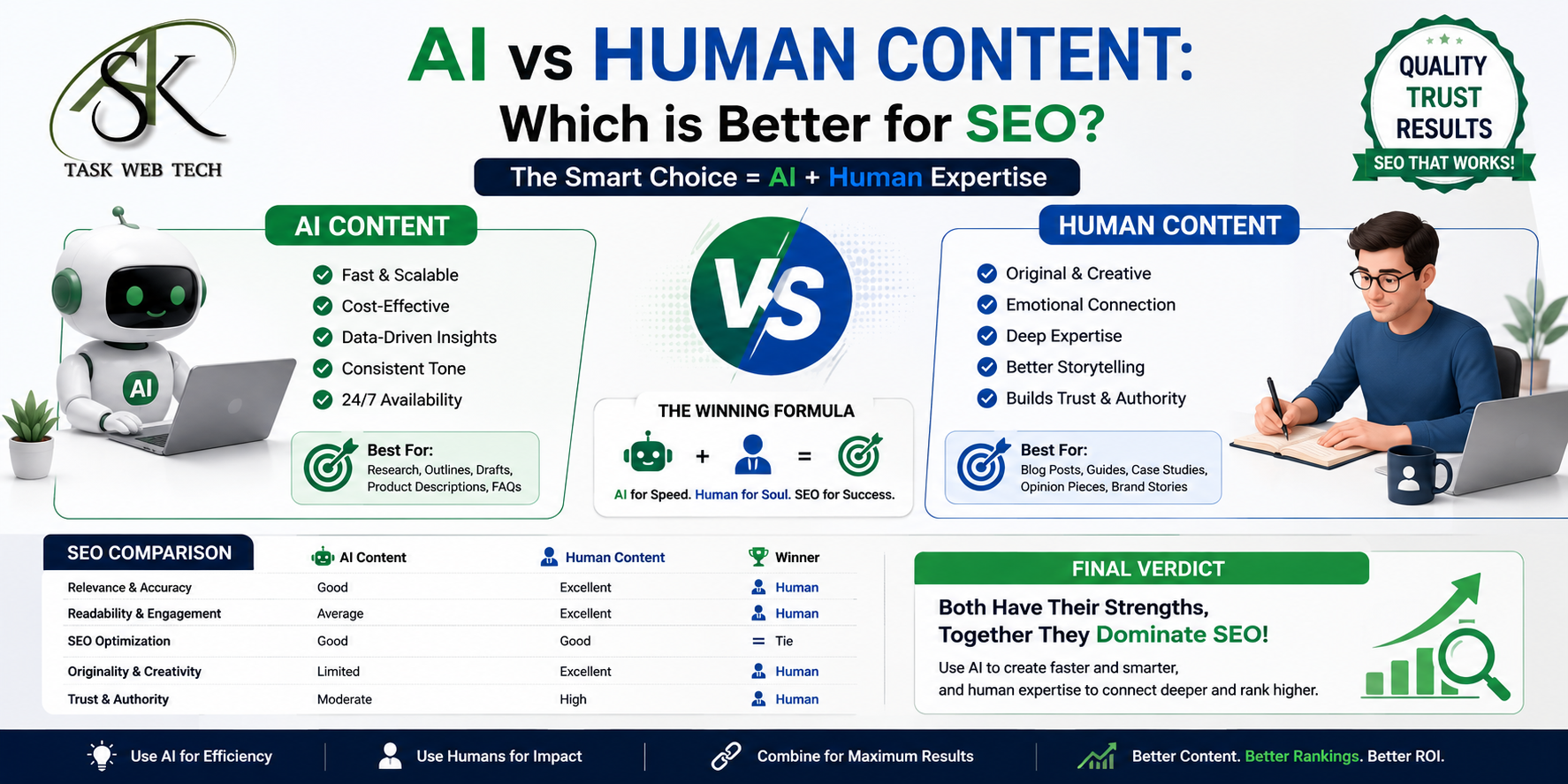
With the changing times in the digital world, it is becoming more and more relevant to wonder whether it is better to use AI-generated content or opt for human-written content in terms of SEO strategies. However, it may not be as simple as selecting either one or the other. By exploring the differences between the two, you will be able to make well-informed decisions that benefit your site.
Thank you for reading this post, don't forget to subscribe!AI-generated Content on the Rise
AI technology has brought about an incredible shift in content generation. Machines capable of machine learning are able to create articles, descriptions, and metadata within a few seconds. If you are managing more than one website or need to work on large-scale content calendars, then there is no doubt that AI provides great benefits in terms of speed and efficiency. Such tools are also able to analyze a number of pages ranking highly and create content based on these patterns.
However, as Google guidelines state, quality and usefulness of the content come first for them. Specifically, Google Webmaster Guidelines prohibit the usage of automatically generated content created to manipulate the search rankings.
Human Interaction in Content Generation
Human-generated content holds unique advantages that artificial intelligence (AI) fails to achieve. The seasoned writer understands the subtleties of context, tone, and target audience psychology. He can draw from his personal life experience, real-life examples, and original research to create compelling stories that evoke an emotional response in the reader. These qualities are valued by Google search engine algorithms that measure user interaction metrics such as click-through rates, time spent on a page, and bounce rates.
Content generation by humans is characterized by expertise and credibility. A person who writes on topics in his industry based on experience will naturally generate authentic content. Search engines recognize and value content based on the Experience, Expertise, Authority, and Trustworthiness (E-E-A-T) attributes, particularly when it.
When Does AI Shine? Smart Uses of AI
Instead of looking at artificial intelligence as something that will replace the human writer, smart SEOs have turned to it as an assistant. The areas where AI shines include:
Research & Data Analysis: Artificial intelligence can analyze large chunks of data in a very short time frame to identify what is trending within your niche and what content is missing.
Drafting Content: With the help of AI, rough drafts of the document can be created, which will then be perfected by a human writer.
Optimizing Meta Tags: AI creates effective meta titles and descriptions in bulk, offering consistency in metadata on larger websites while retaining keyword optimization.
Expanding Content: AI assists writers in expanding their points to develop more detailed explanations, especially when composing thorough content that Google loves.
Reusing Content: AI is adept at converting lengthy articles into social media posts, emails, and other mediums without necessitating an entire rewrite.
SEO Reality: Quality Beats Source
Google does not penalize content just because some kind of AI was involved in the writing process. All that counts is the quality, the uniqueness, and the expertise of the end result. A badly written piece of content by a human writer will give no SEO benefit compared to an AI-written poor piece. High-quality content written using AI technologies can even rank very well.
The essential difference between the two types of content comes from their goals and implementation. Content written with the sole goal of ranking will be at a disadvantage due to a lack of focus on solving users’ problems.
E-E-A-T and the Origin of the Content
When dealing with competitive niches and YMYL subjects, it is important to prove one’s expertise. In this case, human expertise works best. When discussing topics related to medicine, law, finance, and health, readers should be confident that the content is prepared by qualified experts. Artificial intelligence can help, but it is human expertise and authority that matter most here.
In all other cases – technology instruction, product evaluation, how-to articles – this aspect is not that important anymore. While users may prefer precise information, complete coverage of the topic, and clear instructions, they do not really care if artificial intelligence helped to create such content.
AI vs Human Content SEO that with the changing times in the digital world, it is becoming more and more relevant to wonder whether it is better to use AI-generated content or opt for human-written content in terms of SEO strategies. However, it may not be as simple as selecting either one or the other. By exploring the differences between the two, you will be able to make well-informed decisions that benefit your site.
SEO Strategy in Practice: Hybrid SEO Strategy
The best SEO strategy to use in 2026 and beyond involves both methods:
Use AI for efficiency: Utilize artificial intelligence for researching, writing, optimizing, and producing content at scale without compromising its quality.
Apply human expertise: Have subject matter experts validate, enrich, and improve the content produced by artificial intelligence. Inject real-world examples, case studies, and unique information not created by machines.
Think user-first: Regardless of whether the content is produced by humans or AI technology, it should always add value for the user. It should answer all of their queries without fail.
Keep up with industry trends: You need to have clusters of interlinked content about the subject matter you cover. It will help in establishing yourself as an industry expert, no matter how the content is produced.
Optimize through testing: You need to track the performance of different types of content on search results. It will help you in improving your content strategy.
The Search Engine Approach
Search engines have gone past merely matching keywords. They assess the content based on how satisfied the reader is, whether it has some expertise value, and whether it’s fresh or not. Content written by humans which no one reads or interacts with scores less than content that is made by experts and assisted by AI and is valuable to users.
Google’s update on helpful content penalizes content which seems like it has been made purely for search engines and not for humans. This doesn’t matter if it’s human or AI-made content.
Decision-Making Process
When selecting the best strategy for your blog titled “Task Web Tech,” directed at tier-1 countries, take note of the following approach: Implement artificial intelligence in ways that increase productivity and expand the scope of your activities without sacrificing quality. Every post should reflect professional competence in terms of the subject matter being discussed. Insights and practical examples, as well as critical appraisals, should be provided by seasoned experts only.
Conclusion
The argument surrounding whether AI or human content is superior for SEO purposes is rather limited when compared to the actual truth. The answer to the question, “Which one wins in SEO?” is neither. It is simply a combination of the two approaches, which yields the best outcome. SEO requires an effective blend of artificial intelligence for efficiency and research purposes as well as human input regarding the value of information for users.
Companies succeeding in the SERPs are not opting to use either AI or human content alone. They are taking advantage of both to produce high-quality information that provides value to their audiences while also being informative for the search engines. This is how companies achieve success in SEO practices.