
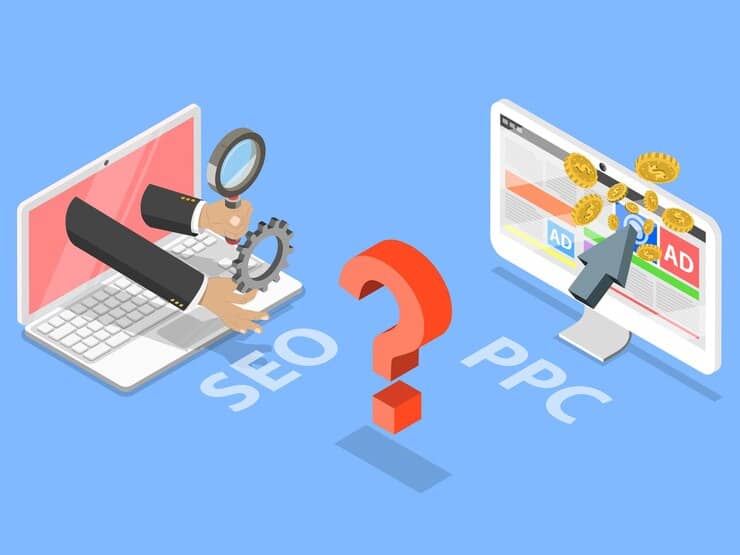
SEO generates long-lasting organic visibility with quality content and optimal site structure, while SEM, through paid advertisements such as Google Ads allows you to gain traffic quickly. For Task Web Tech reaching tier-1 customers in North America (U.S., Canada), Europe (U.K.), and Australia, you should focus primarily on SEO to achieve organic growth, then supplement with SEM for immediate results.
Thank you for reading this post, don't forget to subscribe!Major Differences
SEO enhances a site’s ranking in unpaid search results by establishing authority over time, through things like content quality and technical fixes performed on-page. While SEM leverages paid search (pay-per-click) advertising to reach specific target groups, it creates immediate leads, but requires continuous funding to maintain.
On average, organic SEO has a return on investment (ROI) of 748% over three years. This is significantly greater than SEM’s shorter-term ROIs, where blogs tend to reach breakeven between six to twelve months. SEM provides advertisers with the ability to have complete control over their bids and to retarget customers who have already visited the company’s website. However, it is also exposed to a higher level of competition as well as frequent changes to the search engine algorithms.
| AspectSEO | SEO | SEM |
|---|---|---|
| Traffic Source | Organic, unpaid | Paid ads (PPC) |
| Timeline | 3-12 months for results | Immediate visibility |
| Cost | Time-intensive, low ongoing expense | Pay-per-click, budget-dependent |
| ROI Potential | 748% over 3 years | Quick but lower long-term (36%) |
| Sustainability | Compounding growth | Stops when budget ends |
Several Benefits of Blogs
E-E-A-T and SEO demonstrate expertise by producing original, detailed guides like the tech guides on Task Web Tech. They help establish credibility in the tier-1 marketplace and provide organic traffic through backlinks and social media shares for 53% of all web traffic.
SEM quickly tests keywords and audiences and uses that data to support content creation for SEO—an example of this is a blog campaign that had a 42% growth in traffic as a result of using integrated marketing strategies. For small blog websites, the compounded effects of an ROI of 2,200% on SEO marketing strategies are substantial, especially considering that advertisers experience ad fatigue within months.
- Authority through SEO – Content created by thought-leaders will have a higher ranking and earn 19X more clicks than paid ads.
- Boosting Search Engine Marketing – To quickly drive traffic during peak intervals, a Hybrid strategy will provide you with 25% lower average CPC’s.
- Combined Strategy = Success – Brands found in the top two positions will receive 92% of all clicks.
Use SEO Specific Strategies
Every blog will have a different strategy on how best to rank with their industry, but those who are limited in resources like Task Web Tech should focus on creating Technical Audit reports and Keyword Clusters to generate traffic growth within a 100% increase over several months. Blogs targeting general informational intent words like “SEO vs SEM” can provide organic evergreen traffic through searches from the US and UK.
When launching a product launch or for other types of events where urgent consumer conversions are necessary, Search Engine Marketing (SEM) methods may be used. For example, when an e-commerce business launches a product ecommerce site, it is possible for that e-commerce site to receive a return-on-investment immediately using the SEM method of marketing, however, in addition to SEM, SEO methods will support the retention of that new customer through SEO. As a matter of fact, all companies who have an interest in using SEM marketing will want to also implement SEO as a part of their marketing process.
Since Search Engine Marketing is a paid form of marketing, and there is often a level of competition for that marketing, no company would want to restrict their marketing only to SEM because of the high number of competitors for that space. In fact, 49% of marketers say organic search provides them with the highest return on investment.
Rather than wait until 2026 to begin implementing SEO content that is focused on providing written content for people first, begin implementing that now.
Road Map for Implementation
The year 2023 will be exciting for many companies and websites who want to grow their traffic through search engine optimization (SEO). In this section, we discuss a plan for how we can implement SEO effectively and create an online presence that helps our target audience find us easily.
To do this, we first need to conduct keyword research using a tool like SEMrush, focusing on identifying keywords that receive a lot of search volume but have low competition in terms of how many businesses are competing on them (e.g., “SEO strategies for blogs”). Once we establish which keywords have potential for growth, we can optimize all of our website’s pages for those keywords using proper on-page optimization techniques such as including the keyword naturally within our website content, adding the keyword into all of the H2 headings of the page, and implementing schema markup for E-E-A-T (i.e., Entity-Entity-Attitude-Transaction).
After we have optimized our website for high-volume, low-competition keywords using pain points of our target audience to create content relevant to them, we will build off-page authority through guest blogging and public relations (PR). Public relations for guest blogging are a great way to reach out to bloggers who may not know about us but would benefit from writing an article based on a problem that we solved for one of our clients. Both guest blogging and PR should be done 2 times per week, so we can create 4 new articles every month.
Next, once we have an established website that has been optimized and built off-page authority from guest blogging and PR, we will create pay-per-click (PPC) campaigns focused solely on high-intent keywords from our reports and test multiple ads via A/B testing until we find what works best. We will track the success of our organic rankings using our Google Analytics account, as well as SEM (paid advertising) for cost-per-action (CPA) calculations.
- Months 1 – 3: Establishing the SEO Foundations (Audit, 8+ Posts Per Month)
- At least 4 months later: Experimenting with SEM (to see if there is a return on investment) with reinvested savings.
- Months 1 – On Going: E-E-A-T Audits (Author bios, Source, Testimonials).
Small Agency doubled traffic increase optimizing clusters – This is something that Web Tech could follow with a stronger tech focus.
Final Recommendations
Concentrate on SEO for long-term Tier 1 dominance (70-80%), while positioning SEM tactically (750% return on investment as opposed to uncertainty). This combination of E-E-A-T will be seen as an authority, driving traffic to Task Web Tech long-term.