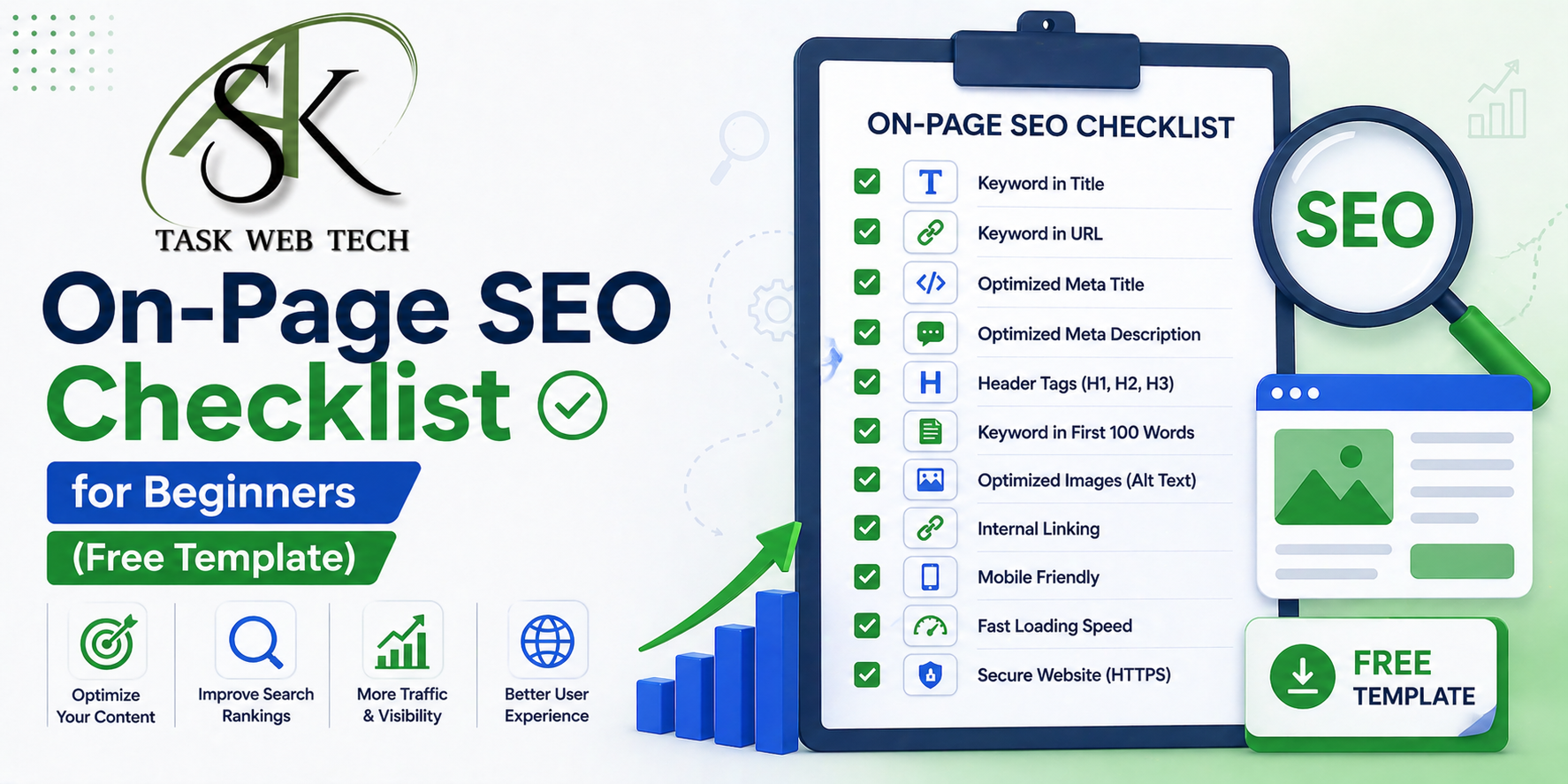
If you’ve newly started a website or blog and are scratching your head wondering why your content isn’t ranking on Google, the explanation is probably in one place — on-page SEO. Getting this right is at the core of every successful website, no matter if you’re in the US, UK, Canada, or Australia.
Thank you for reading this post, don't forget to subscribe!This beginner-friendly on-page SEO checklist walks you through each critical step to optimize your pages like a pro – no prior expertise necessary.
On-Page SEO: What Is It And Why Is It Important ?
All the optimization strategies implemented on your web pages themselves to raise their position in SERPs are collectively known as on-page SEO. You have complete control over on-page SEO, in contrast to off-page SEO (which relies on backlinks).
Google and other search engines utilize intricate algorithms to determine the quality, relevancy, and reliability of your material. When executed properly, on-page SEO tells Google that your page is the best answer to a user’s query, which in turn brings in naturally occurring, unpaid visitors to your site often.
The Ultimate On-Page SEO Checklist for Beginners
✅ 1. Research Keywords Before Writing
It all begins with the appropriate keyword. Before writing a word, identify:
- Primary keyword — the main keyword your page should rank
- Secondary/LSI keywords — related keywords that are relevant to your topic
- Search purpose – does the user want to learn, acquire or compare?
Use free tools like Google Keyword Planner, Ubersuggest, or Google Search Console to uncover strong search volume and low to medium competitive keywords. For Tier-1 audiences (US, UK, Canada, Australia), target terms with clear intent and decent monthly search volume.
✅2. Polish Your Title Tag
Your title tag is the most crucial on-page SEO factor. It shows up as the clickable headline in the Google search results.
Best practices:
- Get your main keyword in early
- He scored his first goal in a 3-1 win over the Eagles.
- Create engaging content so users want to click Avoid keyword stuffing
❌Bad: “SEO Tips SEO Checklist SEO Beginners Guide”
✅ Good: “On-Page SEO Checklist For Beginners – Free Template (2024)”
✅ 3. Write a Catchy Meta Description
Meta descriptions are not a direct ranking element but they do influence CTR (click through rate) considerably.
- Keep character count to 150–160.
- Include your main keyword naturally
- Let them know why they should visit your page
- And then you have the gentle call to action.
A good meta description is like a tiny commercial for your content in the search results.
✅ 4. Maintain a clean, SEO-friendly URL structure
The URL should be brief, descriptive, and keyword-rich.
- ❌ Bad URL: yoursite.com/p=1234.
- ✅ Recommended: yoursite.com/on-page-seo-checklist.
Avoid using dates, stop words (such as “a,” “the,” or “and”), and extraneous numerals in your URLs.
✅ 5. Optimize headings (H1, H2, H3)
A good header arrangement helps readers and search engines understand your material.
- Use only one H1 tag each page, which is typically your blog article title.
- Use H2 tags for the key sections.
- Use H3 tags for subsections within H2.
- Naturally, add your primary and secondary keywords in headings.
✅ 6. Make Sure Your Content Is E-E-A-T Optimized
Google looks at information through the lens of E-E-A-T (Experience, Expertise, Authoritativeness, and Trustworthiness). This is a major ranking criteria, especially for the Tier-1 countries.
Here’s how to implement it:
- Experience Write from first-hand knowledge or practical experience
- Expertise – Exhibit thorough knowledge of the given matter
- Authority – Trusted sources and best practices of the industry
- Trustworthiness – Keep your information correct, up to date and transparent
Add an author profile. Cite relevant sources. Keep your work factually accurate and up to date.
✅ 7. Keyword placement in content
It is critical to incorporate your keyword naturally throughout the material; nevertheless, avoid over-optimizing.
Where to Place Your Keyword:
- First 100 words of your introduction.
- A minimum of 2-3 H2 or H3 headings.
- Naturally inside the body text. (1-2% keyword density)
- The closing paragraph
- Image alt text
✅ 8. Make Images Search Engine Optimized
Images add visual appeal to your content but, if not optimized, might slow down your page load time.
- Reduce file sizes by employing programs such as TinyPNG or ShortPixel.
- Using terms that describe the image, rename the file (for example, on-page-seo-checklist.jpg).
- For better accessibility and search engine rankings, make sure to add alt text to all of your images.
- For quicker download times, use next-gen formats such as WebP.
✅ 9. Make Page Loading Faster
According to Google, page speed is one of the ranking factors. Website visitors in the United States, United Kingdom, and Canada expect pages to load quickly, so slow loading speeds raise bounce rates and lower ranks.
Some quick solutions are:
- Make browser caching work
- Ensure the use of a dependable CDN
- Make JavaScript and CSS smaller.
- Pick a WordPress theme that doesn’t take forever to load
Use GTmetrix or Google PageSpeed Insights to check how fast your site is.
✅ 10. Internal Linking
Including relevant links to other pages on your website is beneficial:
- Spread the link equity around your website.
- Make the user’s journey easier
- Lower the rate of bounces
- Get your pages indexed and crawled by Google quicker.
Every blog post should have at least two external links linking to relevant pages on your site.
✅ 11. Linking to the Outside World (Outbound)
Google values credibility signals from relevant, high-authority external sources. When using data or facts, be sure to link to reputable sources such as government websites, research journals, or prominent figures in the business.
✅ 12. Compatibility with Mobile Devices
Mobile devices account for more than 60% of all web traffic worldwide. Google primarily uses the mobile version of your content for ranking because it employs mobile-first indexing.
Make sure your blog looks great on smartphones and tablets by using Google’s Mobile-Friendly Test.
✅ 13. Implement Schema Markup (Structured Data)
Schema markup is a coding technique that enhances Google’s comprehension of your material, facilitating the display of rich snippets in search results, such as star ratings, FAQs, and how-to steps.
Consider including the following elements into blog posts:
- Article schema
- FAQ schema (if your post includes a Q&A section)
- Breadcrumb schema
Utilize complimentary tools like as Google’s Structured Data Markup Helper to initiate the process without manually editing code.
Free On-Page SEO Template (Quick Reference)
| SEO Element | Status | Notes |
|---|---|---|
| Keyword Research Done | ✅ | Target 1 primary keyword |
| Title Tag Optimized | ✅ | 50–60 characters |
| Meta Description Written | ✅ | 150–160 characters |
| URL Optimized | ✅ | Short & keyword-rich |
| H1 Tag Used Once | ✅ | Contains primary keyword |
| H2/H3 Tags Structured | ✅ | Logical content flow |
| E-E-A-T Applied | ✅ | Author bio + sources cited |
| Images Optimized | ✅ | Alt text + compressed |
| Page Speed Checked | ✅ | Use PageSpeed Insights |
| Internal Links Added | ✅ | 2–5 per post |
| Mobile-Friendly Verified | ✅ | Google Mobile Test |
| Schema Markup Added | ✅ | Article/FAQ schema |
Conclusion
On-page SEO doesn’t have to be hard. By following this checklist for every blog post you publish on Task Web Tech, you’ll be building a solid SEO foundation that compounds over time. Write content that is actually useful, based on your own experiences, and the rankings will take care of themselves.
Bookmark this checklist and utilize it every single time before pushing publish and watch your organic traffic develop steadily in the months ahead.